


Image series 19 / 2026: The Coastal Town of Étretat
A Popular Subject in Art
3 May 2026
|
By: Bettina Pfleging

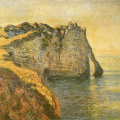
As early as the 19th century, from the 1820s onwards, numerous artists from across Europe were drawn to the small fishing village of Étretat in Normandy, to the Atlantic cliffs with their three rock arches: Porte d’Amont, Porte d’Aval and Manneporte. The play of light on the chalk cliffs offers a seemingly inexhaustible variety of impressions and has been translated into a wide range of fascinating works of art.
Around 170 paintings, drawings, photographs and historical documents, including 24 works by Claude Monet alone, showcase in the exhibition the artistic discovery of the former fishing village of Étretat and the influence of the place on modern painting.
„Monet on the Normandy Coast. The Discovery of Étretat“
19 March until 5 July 2026, Städel Museum, Frankfurt am Main

Eugène Isabey. Rochers d’Etretat, Ausschnitt, contemporary period from 1789 until 1914, graphite, gouache, watercolour, 240 × 330 mm, Paris; RMN Musée Du Louvre, Réunion des musées nationaux

Johan Barthold Jongkind. Plage à Etretat, Ausschnitt, 19th century, watercolourdessin au crayon noir, 147 × 230 mm, Paris; RMN Musée d’Orsay, Réunion des musées nationaux

Victor Hugo. Etretat. Südliche Felsklippe, 9. August 1835, 15.15 Uhr, Ausschnitt, 1835, Grafitstift auf Papier, 8,7 × 15,5 cm, Paris; ConedaKOR Frankfurt, Goethe-Universität Frankfurt am Main, Kunstgeschichtliches Institut

Louis-Aphonse Davanne. Étretat, Ausschnitt, 1862-63, Albuminpapier, Paris; IKARE, Martin-Luther-Universität Halle, Institut für Kunstgeschichte und Archäologien Europas, Zentralbibliothek

Gustave Courbet. Felsen von Etretat, Ausschnitt, 1869, Öl auf Leinwand, 66 × 82 cm, Berlin; bpk – Bildportal der Kunstmuseen, Bildagentur für Kunst, Kultur und Geschichte, Stiftung Preußischer Kulturbesitz, Berlin

Claude Monet. Felsen bei Etretat, Ausschnitt, 1885, Öl auf Leinwand, 65 × 81 cm; ArteMIS, Ludwig-Maximilians-Universität München, Kunsthistorisches Institut

Félix Vallotton. La Manneporte, Étretat, Ausschnitt, 1899, Pastellkreide; Diathek online, Technische Universität Dresden, Institut für Kunstgeschichte, Sächsische Landesbibliothek – Staats- und Universitätsbibliothek Dresden

Henri Matisse. Zwei Rochen, Etretat, Ausschnitt, 1920, Öl auf Leinwand, West Palm Beach; Diathek online, Technische Universität Dresden, Institut für Kunstgeschichte, Sächsische Landesbibliothek – Staats- und Universitätsbibliothek Dresden
