



Image series 22 / 2026: Site: Cologne-Deutz
Lower Germanic Limes
24 May 2026
|
By: Bettina Pfleging

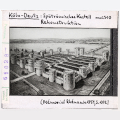
On the north-western edge of the Roman Empire, the River Rhine formed a ‘water’ border stretching from the North Sea coast at Katwijk aan Zee in the Netherlands to the confluence of the Vinxtbach near Bad Hönningen-Rheinbrohl in Germany. This approximately 400 km-long section of the border is Rome’s earliest linear frontier and is known as the Lower Germanic Limes. One of 44 sites is the Divitia fort in Cologne-Deutz. It was built at the beginning of the 4th century AD under Emperor Constantine I the Great as an advanced Roman military outpost on the right bank of the Rhine. It was directly connected to the Roman city of Cologne via a stone bridge.
A new World Heritage Information Centre on the Lower German Limes was opened near the site at the start of the year and can now be visited at the State Garden Show in Neuss.
„Welterbe-Informationszentrum zum Niedergermanischen Limes“
16 April until 11 October 2026, Landesgartenschau in Neuss

Rekonstruktionszeichnung, Stadtanlage; antiker Name Colonia Claudia Ara Agrippinensium, Vordergrund rechts: Kastell Divitia, …, 3. / 4. Jh. n. Chr., Köln; GAUDI, Georg-August-Universität Göttingen, Archäologisches Institut

Köln: Kastell in Deutz, Rekonstruktion; Diasammlung, Universität Hamburg, Kunstgeschichtliches Seminar

Köln-Deutz, Kastell auf Veranlassung von Kaiser Konstantin erbaut, Rekonstruktion [Gesamtansicht], 307 bis 337; DadaWeb, Universität zu Köln, Kunsthistorisches Institut

Grundriss, Kastell Deutz; DadaWeb, Universität zu Köln, Kunsthistorisches Institut

Brückenkopfkastell von Köln-Deutz (Divitia), errichtet unter Konstantin, Gesamtplan, Köln; RUDI, Friedrich-Alexander-Universität Erlangen-Nürnberg, Lehrstuhl für Christliche Archäologie und Kunstgeschichte

Köln: Kastell Deutz, Modell des Osttors, Außenseite; Diasammlung, Universität Hamburg, Kunstgeschichtliches Seminar

Kastell Divita (Deutz) – Rekonstruktion als Bronzemodell aus dem Jahr 2020, Ausschnitt, 2020 / 2026, Bronze, Köln; Upload-Datenbank, prometheus – Das verteilte digitale Bildarchiv für Forschung & Lehre

Station im Historischen Park Deutz: 09. Die römische Konstantinbrücke, Ausschnitt, 2026, Köln; Upload-Datenbank, prometheus – Das verteilte digitale Bildarchiv für Forschung & Lehre
