




Image series 51 / 2025: Daniel Spoerri
Fallenbilder - Tableaux Pièges
10 December 2025
|
By: Bettina Pfleging

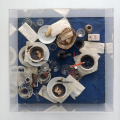
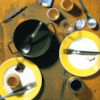
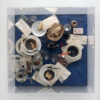
Daniel Spoerri, the Swiss artist of Romanian origin, became famous as the founder of Eat Art and for his ‘tableaux pièges’. He created his first Fallenbild in 1959, followed by many more. These were objects in which he glued together fleeting everyday scenes, such as the traces of a feast with plates, glasses and food leftovers, to create assemblages and thus capture moments in time. The objects fell into his trap, captured forever.
With around 130 works from the period 1961 to 2023, the exhibition provides a comprehensive overview of Daniel Spoerri’s oeuvre and places his works in direct dialogue with an equal number of works from the Falckenberg Collection.
„Daniel Spoerri. I Like Contradictions“
27 September 2025 until 26 April 2026, Deichtorhallen Hamburg

Daniel Spoerri. Le lieu de repos de la famille Delbeck. Divers supports, Ausschnitt, 1960, 3 × 73 × 19,5 cm, Genève; Iconothèque, Université de Genève, Bibliothèque d’art et d’archéologie

Daniel Spoerri. Fallenbild Tuborg 2, Ausschnitt, 1961, Basel; Diathek online, Technische Universität Dresden, Institut für Kunstgeschichte, Sächsische Landesbibliothek – Staats- und Universitätsbibliothek Dresden

Daniel Spoerri. Le repas hongrois, tableau-piège (Die ungarische Mahlzeit), Ausschnitt, 1963, Glas, Metall, Porzelan, Stoff, 103 × 205 × 33 cm, Paris; Virtuelle Diathek, Universität Hamburg, Kunstgeschichtliches Seminar

Daniel Spoerri. Restaurant der City-Galerie, Ausschnitt, 1965; Diathek online, Technische Universität Dresden, Institut für Kunstgeschichte, Sächsische Landesbibliothek – Staats- und Universitätsbibliothek Dresden

Daniel Spoerri. Tableau-piège [19. Oktober 1972], Ausschnitt, 1972, Assemblage auf Holz, 70 × 70 × 18 cm; ConedaKOR Frankfurt, Goethe-Universität Frankfurt am Main, Kunstgeschichtliches Institut

Daniel Spoerri. Tableau piège, Ausschnitt, 1972, Tischplatte, Geschirr, Essensreste, diverse Materialien; Bildarchiv des Kompetenzzentrums für Kulturerbe, Universität Paderborn, Kompetenzzentrum für Kulturerbe

Daniel Spoerri. Laid Table, Offset-Collage, Ausschnitt, 1973; Diathek online, Technische Universität Dresden, Institut für Kunstgeschichte, Sächsische Landesbibliothek – Staats- und Universitätsbibliothek Dresden

Daniel Spoerri. Nature morte, tableau piège. Technique mixte, Ausschnitt, 1974, 75 × 115 × 30 cm, Genève; Iconothèque, Université de Genève, Bibliothèque d’art et d’archéologie
