


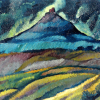


Image series 30 / 2026: Adolf Erbslöh
Imagination as a Structuring Force
19 July 2026
|
By: Bettina Pfleging

He was an influential, pioneering, significant, yet often overlooked modernist painter. Through his works and his close connections within the Munich art scene, the German artist Adolf Erbslöh played a decisive role in shaping the artistic climate around 1910; in 1929, with his essay ‘Imagination and Form’, he formulated his own theory of art, which understands imagination not as the antithesis of order, but as its very source. In his landscapes, cityscapes and still lifes, imagination becomes a structuring force: vibrant colours, clear lines and layered planes are the means of a reflective way of seeing.
Around 40 paintings by Adolf Erbslöh in the exhibition invite visitors to rediscover his unmistakable visual language and his unique visual world.
„Imagination & Form. Adolf Erbslöh’s Path to Modernism“
26 April to 27 September 2026, Franz Marc Museum, Kochel am See

Adolf Erbslöh. Tennisplatz, Ausschnitt, 1910, Öl auf Leinwand, 54 × 66,5 cm, Iowa City; ConedaKOR, Universität des Saarlandes, Fachrichtung Kunst- und Kulturwissenschaft

Adolf Erbslöh. Kapelle, Ausschnitt, 1911, Öl, Pappe, 62 × 55 cm; ConedaKOR, Universität des Saarlandes, Fachrichtung Kunst- und Kulturwissenschaft

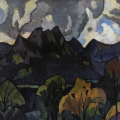
Adolf Erbslöh. Gebirge, Ausschnitt, 1911, Öl, Pappe, 69,5 × 99,5 cm, Karlsruhe; ArteMIS, Ludwig-Maximilians-Universität München, Kunsthistorisches Institut

Adolf Erbslöh. Steilküste bei Ragusa, Ausschnitt, 1911, Pappe, 47 × 36,5 cm; ConedaKOR Frankfurt, Goethe-Universität Frankfurt am Main, Kunstgeschichtliches Institut

Adolf Erbslöh. Desenberg, Ausschnitt, 1915, Öl auf Leinwand; Diathek online, Technische Universität Dresden, Institut für Kunstgeschichte, Sächsische Landesbibliothek – Staats- und Universitätsbibliothek Dresden

Adolf Erbslöh. Häuser und Bäume, Ausschnitt, 1920, Öl auf Leinwand, 39,5 × 48,3 cm; Bildarchiv des Kompetenzzentrums für Kulturerbe, Universität Paderborn, Kompetenzzentrum für Kulturerbe

Adolf Erbslöh. Positano, Ausschnitt, 1923, Velbert; Diathek online, Technische Universität Dresden, Institut für Kunstgeschichte, Sächsische Landesbibliothek – Staats- und Universitätsbibliothek Dresden

Adolf Erbslöh. Bäume im Englischen Garten, Ausschnitt, 1927, Öl auf Leinwand, auf Karton kaschiert, 40,2 × 30 cm; RUDI, Friedrich-Alexander-Universität Erlangen-Nürnberg, Kunsthistorisches Institut
