


Image series 40 / 2026: Mary Magdalene
A Multifaceted Cultural Icon
27 September 2026
|
By: Bettina Pfleging

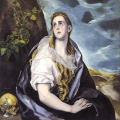
For centuries, Mary Magdalene has inspired artists to create ever-new depictions of her. As a key witness to the crucifixion and the Resurrection, she was initially revered, before, through her amalgamation with other biblical female figures, she came to be increasingly portrayed as a repentant sinner and penitent. Contemporary artworks place Mary Magdalene at the centre as a self-assured and self-determined woman, interpreting her as a figure who challenges and reinterprets traditional boundaries.
The exhibition brings together a total of over 100 paintings, sculptures and prints, ranging from the Middle Ages to the present day. They offer a comprehensive overview of the artistic and emotional range of depictions of Mary Magdalene.
„Mary Magdalene. Sin. Pray. Love.“
17 September 2026 until 17 January 2027, Städel Museum, Frankfurt am Main
Digitorial

Giovanni Gerolamo Savoldo. Maria Magdalena, Ausschnitt, um 1528/1530, Öl auf Leinwand, 79 × 84 cm, London; Digitale Diathek, Institut für Kunstgeschichte, Justus-Liebig-Universität Gießen

Jan van Scorel. Maria Magdalena, Ausschnitt, ca. 1530, Öl auf Holz, 66,3 × 76 cm, Amsterdam; HeidICON – Ostasienwissenschaften, Universitätsbibliothek, Ruprecht-Karls-Universität Heidelberg

El Greco. Büßende Maria Magdalena, Ausschnitt, ca. 1580 bis 1583, Öl auf Leinwand, 108 × 101,3 cm, Worcester; ConedaKOR Frankfurt, Kunstgeschichtliches Institut, Goethe-Universität Frankfurt am Main

Giovanni Lanfranco. Maria Magdalena wird von Engeln gen Himmel getragen, Ausschnitt, um 1616, Öl auf Leinwand, 77,5 × 108,5 cm, Neapel; Digitale Diathek, Institut für Kunstgeschichte, Justus-Liebig-Universität Gießen

Georges de la Tour. Magdalena im Spiegel (Madeleine Fabius), Ausschnitt, um 1635-40, Öl auf Leinwand, Washington; Diathek online, Institut für Kunstgeschichte, Technische Universität Dresden, Sächsische Landesbibliothek – Staats- und Universitätsbibliothek Dresden

Elisabetta Sirani. Maria Magdalena, die Büßerin, Ausschnitt, 1663, Öl auf Leinwand, 113,5 × 94 cm, Besançon; ArteMIS, Kunsthistorisches Institut, Ludwig-Maximilians-Universität München

Francesco Hayez. Die heilige Maria Magdalena weinend in der Wüste, Ausschnitt, 1825, 131,5 × 112,6 cm; EasyDB, Institut für Kunstgeschichte, Universität Bern, Universitätsbibliothek Bern

Max Beckmann. Christus und die Sünderin, Ausschnitt, 1917; Imago, Institut für Kunst- und Bildgeschichte, Humboldt-Universität zu Berlin
